


Ciccarelli: Psychology_5 (5th Edition)
5th Edition
ISBN: 9780134477961
Author: Saundra K. Ciccarelli, J. Noland White
Publisher: PEARSON
expand_more
expand_more
format_list_bulleted

Related questions
Question
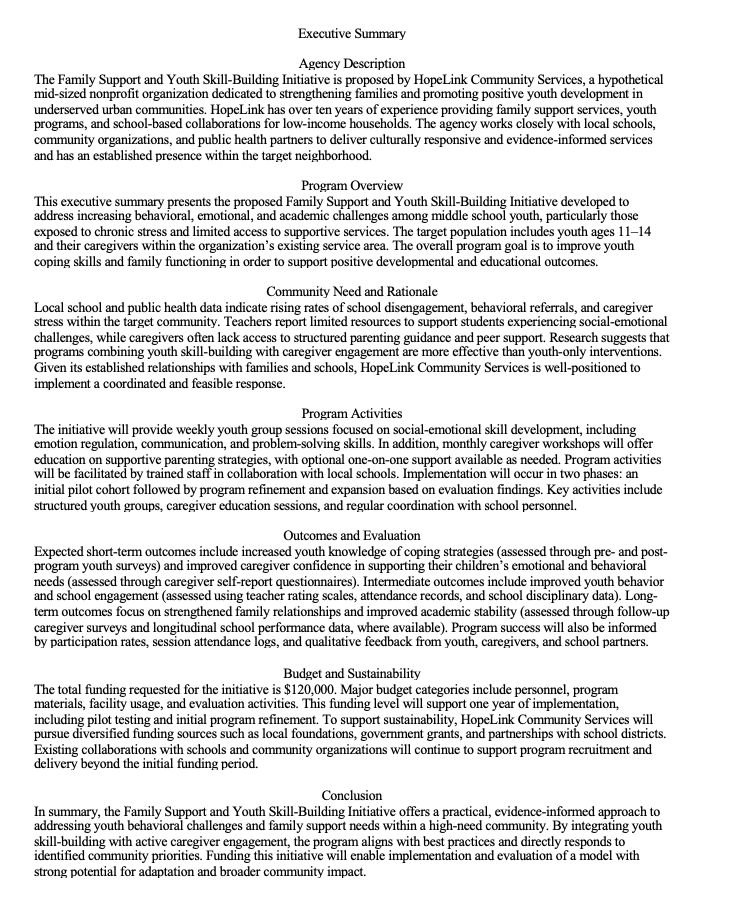

Transcribed Image Text:Executive Summary
Agency Description
The Family Support and Youth Skill-Building Initiative is proposed by HopeLink Community Services, a hypothetical
mid-sized nonprofit organization dedicated to strengthening families and promoting positive youth development in
underserved urban communities. HopeLink has over ten years of experience providing family support services, youth
programs, and school-based collaborations for low-income households. The agency works closely with local schools,
community organizations, and public health partners to deliver culturally responsive and evidence-informed services
and has an established presence within the target neighborhood.
Program Overview
This executive summary presents the proposed Family Support and Youth Skill-Building Initiative developed to
address increasing behavioral, emotional, and academic challenges among middle school youth, particularly those
exposed to chronic stress and limited access to supportive services. The target population includes youth ages 11-14
and their caregivers within the organization's existing service area. The overall program goal is to improve youth
coping skills and family functioning in order to support positive developmental and educational outcomes.
Community Need and Rationale
Local school and public health data indicate rising rates of school disengagement, behavioral referrals, and caregiver
stress within the target community. Teachers report limited resources to support students experiencing social-emotional
challenges, while caregivers often lack access to structured parenting guidance and peer support. Research suggests that
programs combining youth skill-building with caregiver engagement are more effective than youth-only interventions.
Given its established relationships with families and schools, HopeLink Community Services is well-positioned to
implement a coordinated and feasible response.
Program Activities
The initiative will provide weekly youth group sessions focused on social-emotional skill development, including
emotion regulation, communication, and problem-solving skills. In addition, monthly caregiver workshops will offer
education on supportive parenting strategies, with optional one-on-one support available as needed. Program activities
will be facilitated by trained staff in collaboration with local schools. Implementation will occur in two phases: an
initial pilot cohort followed by program refinement and expansion based on evaluation findings. Key activities include
structured youth groups, caregiver education sessions, and regular coordination with school personnel.
Outcomes and Evaluation
Expected short-term outcomes include increased youth knowledge of coping strategies (assessed through pre- and post-
program youth surveys) and improved caregiver confidence in supporting their children's emotional and behavioral
needs (assessed through caregiver self-report questionnaires). Intermediate outcomes include improved youth behavior
and school engagement (assessed using teacher rating scales, attendance records, and school disciplinary data). Long-
term outcomes focus on strengthened family relationships and improved academic stability (assessed through follow-up
caregiver surveys and longitudinal school performance data, where available). Program success will also be informed
by participation rates, session attendance logs, and qualitative feedback from youth, caregivers, and school partners.
Budget and Sustainability
The total funding requested for the initiative is $120,000. Major budget categories include personnel, program
materials, facility usage, and evaluation activities. This funding level will support one year of implementation,
including pilot testing and initial program refinement. To support sustainability, HopeLink Community Services will
pursue diversified funding sources such as local foundations, government grants, and partnerships with school districts.
Existing collaborations with schools and community organizations will continue to support program recruitment and
delivery beyond the initial funding period.
Conclusion
In summary, the Family Support and Youth Skill-Building Initiative offers a practical, evidence-informed approach to
addressing youth behavioral challenges and family support needs within a high-need community. By integrating youth
skill-building with active caregiver engagement, the program aligns with best practices and directly responds to
identified community priorities. Funding this initiative will enable implementation and evaluation of a model with
strong potential for adaptation and broader community impact.

Transcribed Image Text:Note:
1) Create a cover page to provide the title of the proposal and authors.
2) Make sure that you provide the reference list.
3) Use tables/figures and appendix to attach (1) timeline and (2) estimated budget
and (3) supplementary document(s). For example, you can use a table for budget
estimate, a figure/chart for timeline, and an appendix for the revised/final Logic
Model chart.
4) Use APA style throughout the document, including cover page and reference list.
5) For this assignment, you will represent a hypothetical agency to submit this
summary/proposal. Therefore, you can provide information based on your
assumptions, especially regarding the agency/organization that you represent.
NO AI AND NO PLAGIARISM
Expert Solution

This question has been solved!
Explore an expertly crafted, step-by-step solution for a thorough understanding of key concepts.

Step by stepSolved in 2 steps

Knowledge Booster

Recommended textbooks for you
- Ciccarelli: Psychology_5 (5th Edition)PsychologyISBN:9780134477961Author:Saundra K. Ciccarelli, J. Noland WhitePublisher:PEARSON
 Cognitive PsychologyPsychologyISBN:9781337408271Author:Goldstein, E. Bruce.Publisher:Cengage Learning,
 Introduction to Psychology: Gateways to Mind and ...PsychologyISBN:9781337565691Author:Dennis Coon, John O. Mitterer, Tanya S. MartiniPublisher:Cengage Learning
  Psychology in Your Life (Second Edition)PsychologyISBN:9780393265156Author:Sarah Grison, Michael GazzanigaPublisher:W. W. Norton & Company
 Cognitive Psychology: Connecting Mind, Research a...PsychologyISBN:9781285763880Author:E. Bruce GoldsteinPublisher:Cengage Learning
 Theories of Personality (MindTap Course List)PsychologyISBN:9781305652958Author:Duane P. Schultz, Sydney Ellen SchultzPublisher:Cengage Learning
Ciccarelli: Psychology_5 (5th Edition)
Psychology
ISBN:9780134477961
Author:Saundra K. Ciccarelli, J. Noland White
Publisher:PEARSON
Cognitive Psychology
Psychology
ISBN:9781337408271
Author:Goldstein, E. Bruce.
Publisher:Cengage Learning,
Introduction to Psychology: Gateways to Mind and ...
Psychology
ISBN:9781337565691
Author:Dennis Coon, John O. Mitterer, Tanya S. Martini
Publisher:Cengage Learning
Psychology in Your Life (Second Edition)
Psychology
ISBN:9780393265156
Author:Sarah Grison, Michael Gazzaniga
Publisher:W. W. Norton & Company
Cognitive Psychology: Connecting Mind, Research a...
Psychology
ISBN:9781285763880
Author:E. Bruce Goldstein
Publisher:Cengage Learning
Theories of Personality (MindTap Course List)
Psychology
ISBN:9781305652958
Author:Duane P. Schultz, Sydney Ellen Schultz
Publisher:Cengage Learning